PNC Logo
Pekingese and Japanese Chin Rescue and Re-homing
Quote
Home
About Us
About Our Breeds
Available Dogs
Adoption Application
Forever Fosters
Volunteer Application
About Puppy Mills
Success Stories
Favorite Links
Would you like to make a tax deductible donation to our General Medical Fund or to sponsor one of our dogs? Make sure you make a notation how the funds should be used, as a Buddy Donation, General Donation or to Sponsor a Pet - no amount is too small!
Please consider visting iGive.com. A portion of your purchase from major, upscale retail stores will then come back to PNC Midwest when you choose us as the recipient of this donation.
Another way to help donate to PNC Midwest is by downloading a search engine through GoodSearch.com Get started right now and download the GoodSearch toolbar!
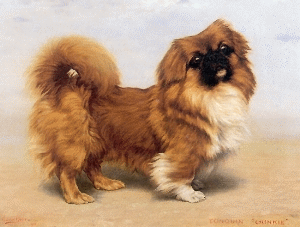
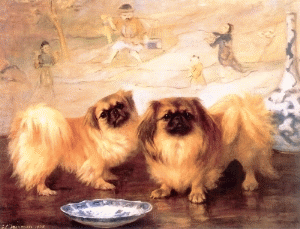
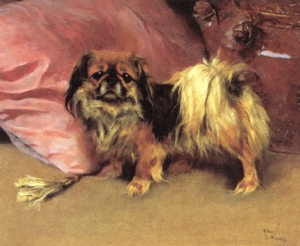
Painting by Gabriel Blair Painting by Francis Fairman Painting by Arthur Wardle

About our Breeds

Pekingese

Description

The Pekingese has an extravagant, long, straight-flowing coat that has profuse feathering and comes in all colors. It has a broad head that is wide between their large, dark, lucid and slightly prominent eyes. The face is flat with a dark, wrinkled muzzle, and drooping heart-shaped, long feathering ears. Their necks are short and thick. When their mouth is closed, neither teeth nor tongue should show. These tiny, heavy boned dogs have a characteristic rolling gait.

Temperament

Pekingese are very brave little dogs, courageous to the point of foolhardiness! They are sensitive, independent and extremely affectionate with their master, but are wary of strangers. They are obstinate, self-willed and may be difficult to feed and are sometimes known to refuse to eat as much to show dominance over its owner as to lack of appetite. If overfed, Pekingese will quickly become overweight. They are loving to the point of jealousy. They tend to bark a lot and make good watchdogs. Not recommended for young children who are too rough. This breed may be difficult to housebreak.

Height, Weight

Height: 6-9 inches (30.4-45 cm), Weight: 8-10 pounds (3.6-4.5 kg) Any Pekingese under 6 pounds is called a sleeve Pekingese. It is the smallest member of the Pekingese family, and the most popular size during the breed's development in China. To be a sleeve it must be 6 pounds (2.7 kg) or under, anything over that is not a considered a sleeve. In between 6 and 8 (2.7-3.6 kg) pounds is considered a Mini Pekingese.

Health Problems

Pekingese tend to catch colds very easily. Very difficult births. Prone to herniated disks and dislocated kneecaps. Trichaiasis (lashes growing inwards toward the eyeballs). Breathing problems and heart problems are also common.

Living Conditions

The Pekingese are good for apartment life. They are relatively inactive indoors and will do okay without a yard.

Exercise

Pekingese need a daily walk. Play will take care of a lot of their exercise needs, however, as with all breeds, play will not fulfill their primal instinct to walk. Dogs that do not get to go on daily walks are more likely to display behavior problems. They will also enjoy a good romp in a safe open area off lead, such as a large fenced in yard. Get your Peke accustomed to the leash when they are still a puppy. Some owners have told me their Peke will walk up to 4 miles on a nightly walk.

Life Expectancy

With healthy dogs, about 10-15 years.

Grooming

Daily combing and brushing of the very long, double coat is essential. Take extra care around the hindquarters, which can become solid and matted. Females shed the undercoat when in season. Dry shampoo regularly. Clean the face and eyes daily and check the hairy feet for burrs and objects that stick there. These dogs are average shedders.

Origin

Pekingese where regarded as manifestation of the legendary Foo Dog that drove away spirits. They were venerated as semi-divine by the Chinese. Commoners had to bow to them; you were punished by death if you stole one, and when an emperor died, his Pekingese were sacrificed so that they could go with him to give protection in the afterlife. In 1860 the Pekingese reached the West. British and French troops over ran the Summer Palace during the Second Opium War. Imperial Guards were ordered to kill the little dogs to prevent them from falling into the hands of the "foreign devils," but five Pekingese survived and were taken to Queen Victoria, who named it appropriately, "Looty." It is from these canine spoils of war that the modern Pekingese is descended. In 1893 the breed was first shown in Britain. It was recognized in the US in 1909.


Painting by Francis Fairman Painting by Arthur Wardle Painting by Francis Fairman

Japanese Chin

Description

The Japanese Spaniel is also called the Japanese Chin or Chin. It is a dainty little spaniel with a short, broad face, and a soft, feathered coat. A thick ruff covers the neck and chest. The forehead is quite round, with a well-defined stop. The nose is wide and the nostrils open. It has an extremely short nasal canal. Black and white Japanese Spaniels must have black noses. In other dogs, the nose color should match the color of the coat markings. The expressive, protruding eyes are dark and almond- shaped. The teeth form a level or undershot bite. The upside-down, v-shaped ears are well covered with hair. The body is about the same length as it is high. The front legs are straight and fine-boned. The coat comes in white with colored patches, most often black, but sometimes red, lemon, orange, sable or brindle. The feathered tail curls up over the back. Smaller dogs are preferred. The Japanese Spaniel has an elegant high-stepping gait.

Temperament

The Japanese Spaniel is a charming, lively, and happy animal. Pleasant, loving and intelligent. Affectionate and extremely devoted to its master. This breed loves everyone it is familiar with, but is known to be reserved around strangers and in unfamiliar situations. With its gentle ways and charming manners, it is perhaps best suited to homes in which there are no small children. If you do have small children, teach them to be nice and gentle with the dog. They are good with other dogs and pets. The Japanese Spaniel has a mind of its own and likes to be the center of attention. This breed is not a barker. Mild mannered, elegant, yet playful. Sensitive, agile, dainty and clean. This breed is more obedient than most toy breeds and are good dogs for learning tricks. They are also good watchdogs. The Japanese Spaniel can be taught to perform tricks.

Height, Weight

Height: 7-11 inches (18-28 cm) Weight: 4-15 pounds (2-7 kg) There are two classes of Japanese Spaniels: under 7 pounds, and over 7 pounds.

Health Problems

Like many short-faced breeds, the Japanese Spaniel tends to wheeze and snore. They are prone to eye and respiratory problems and heat prostration. Some lines are prone to distemper. Your veterinarian may choose to adjust the immunization schedule.

Living Conditions

The Japanese Spaniel is a good dog for apartment life. They are moderately active indoors and will do okay without a yard. This breed is somewhat sensitive to temperature extremes.

Exercise

Chin do not require a great deal of exercise, however they do need to be taken on a daily walk. They will enjoy the opportunity to play in an open yard.

Life Expectancy

An average of 10-12 years, but known to live up to 15.

Grooming

A few minutes each day will keep the coat looking beautiful. Comb out tangles and brush lightly, lifting the hair to leave it standing out a little. A professional dog groomer can show you the correct technique. Clean the eyes every day and check the ears regularly for any signs of infection. Dry shampoo occasionally and bathe only when necessary. This breed is an average shedder.

Origin

Despite its name, the Japanese Spaniel is probably native to Korea - the breed later being developed in Japan and introduced to Europe in 1700. It became a favorite of Japanese Court, and was often offered as a royal gift. Its greatest moment of popularity came in 1853 when a pair was given as a gift to Queen Victoria from Commodore Perry when he returned from his historic mission to open Japan to world trade. The Japanese Spaniel was renamed "Japanese Chin" by the AKC in 1977. Regardless of the name, the breed has always been, first and foremost, a companion dog.


This is just the beginning, but we want you to be sure that you understand these wonderful little dogs and that you are ready to give them their forever home.


This website has been designed and is being maintained by Onavlis Art
All the pictures on this website are the properties of their respective owners
and may not be copied or used to any other purpose without their written permission.
Home | About Us | About Our Breeds | Available Dogs | Adoption Application | Forever Fosters | Volunteer Application 
About Puppy Mills | Sucess Stories | Favorite Links